
water leak remediation SYDNEY

Identifying where water is entering a building solves one problem and immediately creates another: the defect still needs to be fixed. Poor repairs that address surface symptoms without resolving the underlying cause will fail again, often sooner than expected, and the resulting damage compounds with every wet season.


At Difficult Access Services, we carry out professional water leak remediation for commercial properties and strata buildings throughout Sydney. Using rope access abseiling, our technicians get directly to the external source of the problem at any height, whether that's a failed membrane on a twelfth-floor balcony or a deteriorated joint halfway up a facade, and carry out the repair on the spot without scaffolding or boom lifts.


For water leak remediation in Sydney, trust Difficult Access Services to locate the source, fix it properly, and back it up with full documentation.
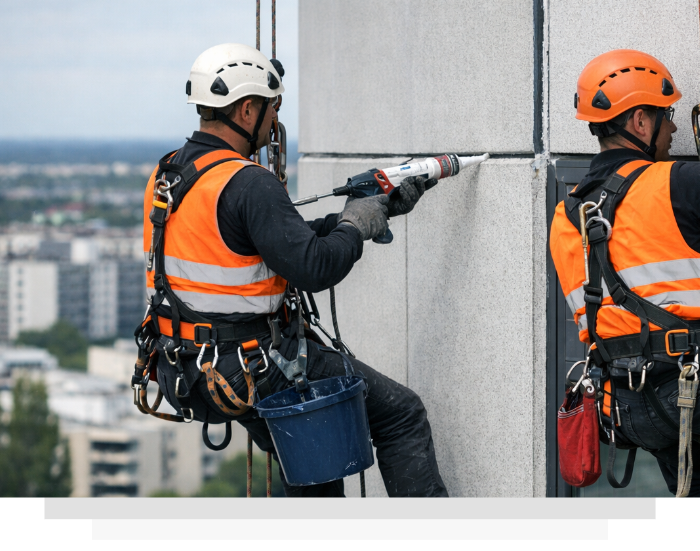
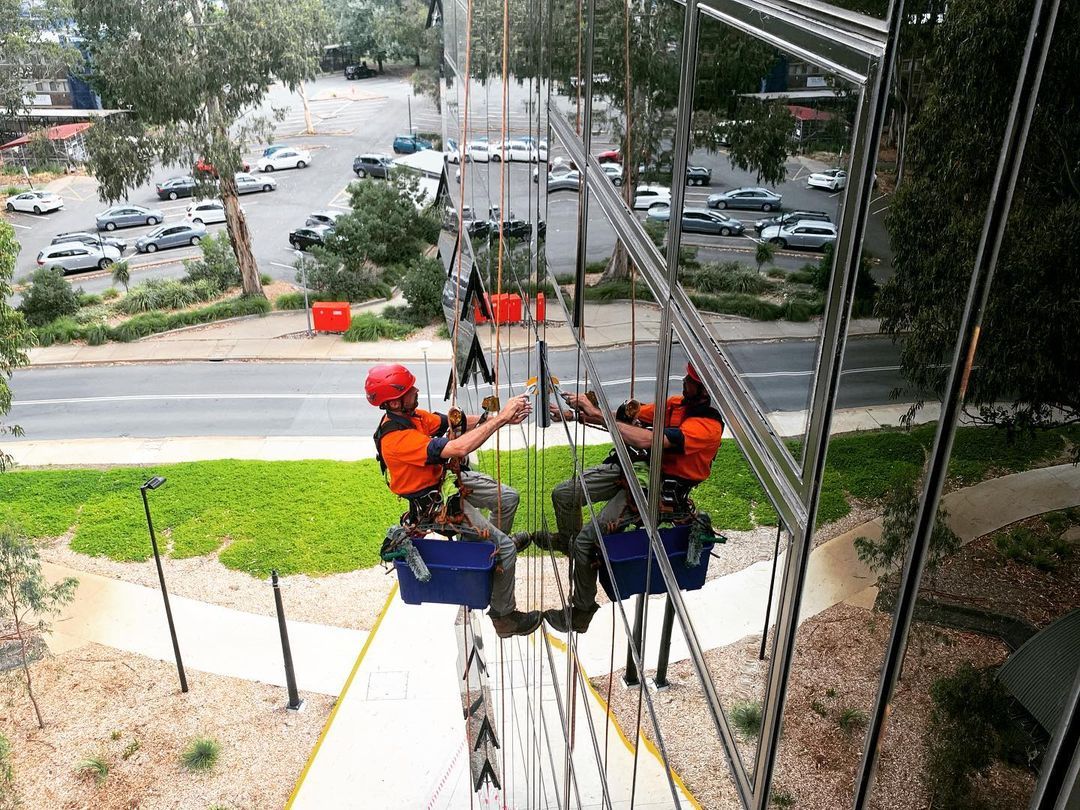
Two abseilers in orange safety vests cleaning a high-rise building exterior on ropes

Our Water Leak Remediation Services Include:
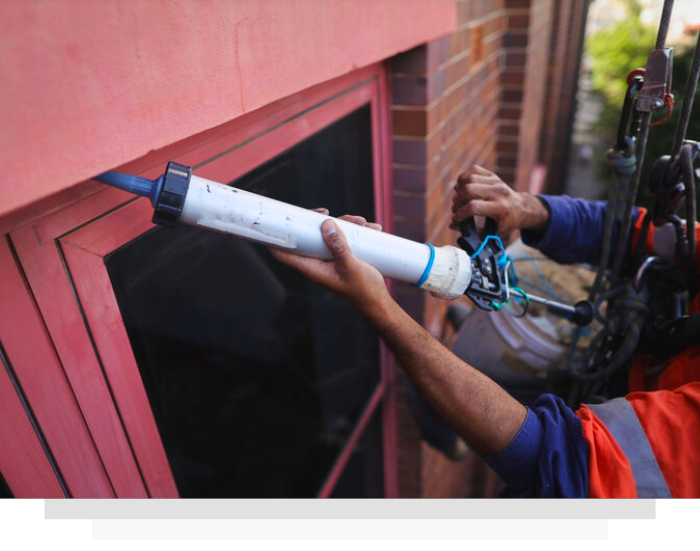
A worker suspended in a harness uses a caulk gun to apply sealant around the frame of a window on a brick building.

Joint & Sealant Replacement

Sealant around window frames, expansion joints, and cladding interfaces breaks down over time due to UV exposure and building movement. We strip out the failed material completely and re-seal using high-grade, UV-stable products appropriate to the substrate, across the entire building face in one visit.
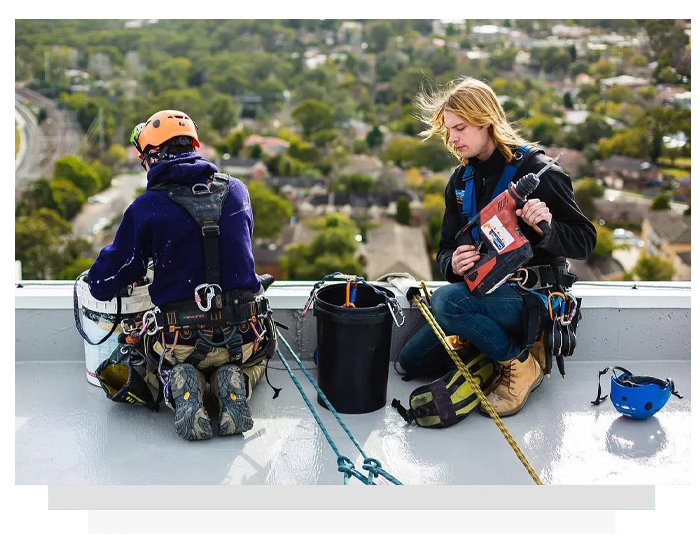
Two workers in safety harnesses and helmets kneel on a rooftop, preparing tools and ropes for high-altitude work.

Waterproofing Membrane Repair & Replacement

Balcony decks, rooftops, and podium areas rely on intact membranes to keep water out of the structure below. Where membranes have cracked, separated, or been penetrated, we cut back to sound material and install new membrane or liquid-applied waterproofing systems rated for the conditions.
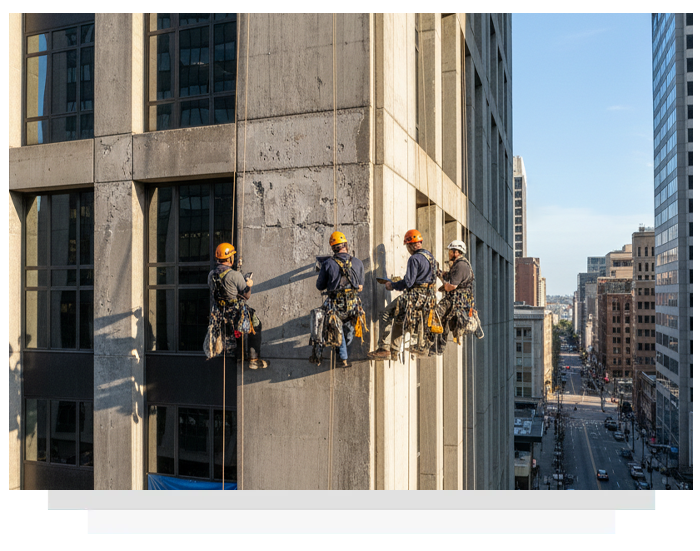
Abseilers suspended on ropes working on a tall office building facade in a city.

Crack Injection & Sealing

Structural and non-structural cracks in concrete elements create persistent hidden leak pathways that worsen over time. Depending on whether the crack is active or dormant, we apply flexible polyurethane or rigid epoxy injection systems to seal the defect permanently from the external face.
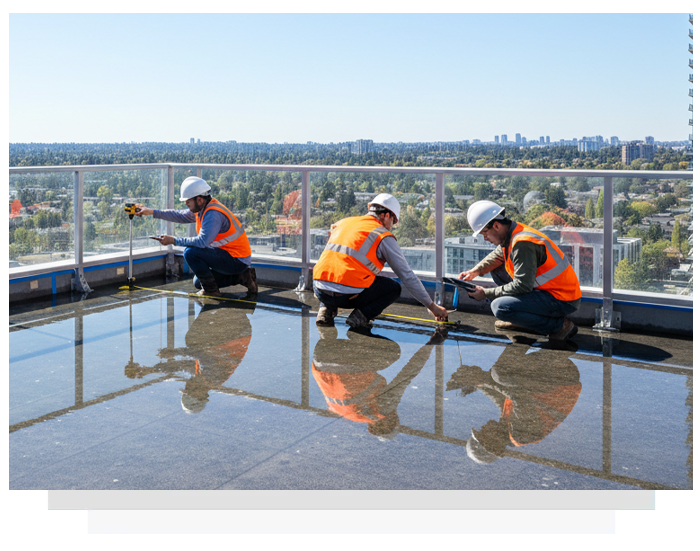
Three construction workers in safety vests and helmets kneel on a rooftop, working beside a reflective surface.

Balcony & Podium Waterproofing

Balcony and podium waterproofing failures are a leading cause of water damage in Sydney strata buildings. We carry out targeted or full-area membrane works via rope access, including upstand repairs and drainage rectification that prevent water from bypassing the waterproofing layer entirely.
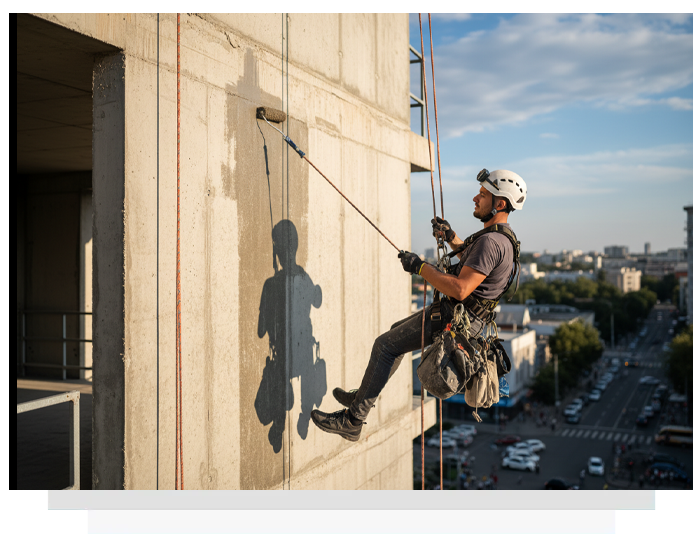
Worker rappelling down a tall building, working on an exterior wall above a city street.

Facade Recoating & Protective Treatments

Rendered and masonry facades become increasingly porous as surface coatings age and break down. We apply water-repellent coatings and sealers at height to protect the facade and restore its ability to shed water, extending the service life of the substrate and reducing the frequency of future remediation work.
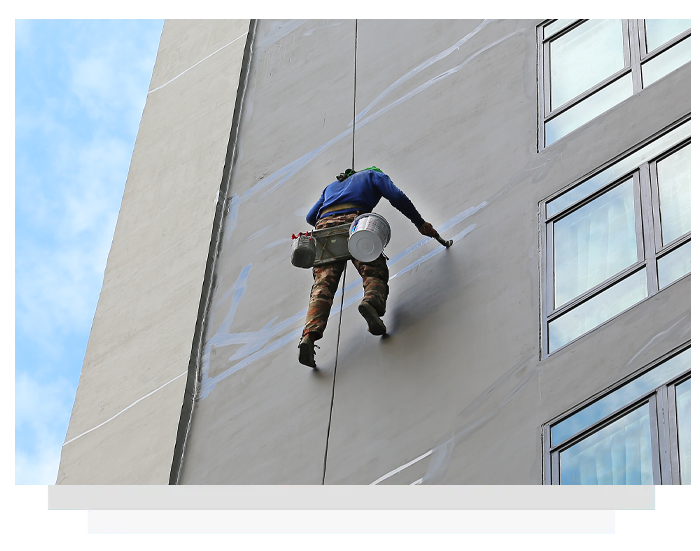
Abseiler rappelling down a tall building facade with equipment in hand

Concrete Repair & Render Patching

Water that has been entering a building for an extended period frequently causes secondary damage: spalling concrete, hollow or delaminated render, and corroded steel reinforcement. After the ingress source is sealed, we reinstate affected concrete and render to match the surrounding surface finish.

The Difficult Access Difference

height safety tools

Rope Access Reaches the Actual Defect

Most external building defects sit well above what can be reached from a ladder or internal access point. Our abseilers position themselves directly at the repair location, which produces better results than working around access limitations and relying on indirect methods.

A person is surrounded by three stars in a circle.

30+ Years on Sydney Buildings

Our background in high-rise maintenance across Sydney and Wollongong means our technicians have seen and fixed a wide variety of defect types across many different building ages, facade systems, and construction methods.

No Scaffolding, No Extended Site Presence

We mobilise quickly and clear the site efficiently, with no scaffolding to erect or dismantle and no prolonged disruption to surrounding areas. For occupied buildings, this difference is significant.

firm handshake

Compliance & Safety First

All remediation work is carried out in full compliance with Australian Standards and industry safety regulations. Our technicians are rigorously trained, certified, and equipped to work safely at any height on any building type.
Water Leak Remediation Sydney FAQs

  • What is water leak remediation?

    Remediation is the process of repairing the defects that allow water to enter a building. It differs from detection, which identifies where the problem is, and from internal reinstatement, which restores finishes after the damage is done. Remediation sits in the middle: fixing the source so that water can no longer get in and further damage stops accumulating. Even a minor, slow leak that goes unaddressed can lead to mould growth, structural deterioration, and significantly more expensive repairs over time, so acting on a confirmed leak quickly is always the better outcome.

  • How do you decide which repair method to use?

    The right method depends on the defect type, the substrate it affects, and whether the crack or failure is still moving. A live crack in a facade requires a flexible sealant or polyurethane injection rather than a rigid epoxy, while a failed balcony membrane needs to be cut back and replaced rather than simply coated over. Our technicians conduct a thorough assessment of each defect at the source before specifying a repair approach.

  • Can you remediate a leak without opening up internal walls or ceilings?

    Usually yes. The majority of water ingress in multi-storey buildings originates externally, and external repairs carried out at the source remove the need for internal demolition or unnecessary digging. There are cases where internal wet area waterproofing is the culprit, but these are less common in the types of buildings we work on.

  • How long before a repaired leak can be tested?

    Curing times vary by product and conditions, but most sealants and coatings reach full cure within 24 to 72 hours. We can carry out post-repair hose or spray testing — including simulating heavy rain conditions — once the materials have cured, which confirms the repair has been successful before we leave site.

  • What if the leak comes back after remediation?

    Recurrence almost always points to an incomplete diagnosis rather than a product or workmanship failure. If a building has multiple entry points and only one is addressed, water will continue to appear internally via the others. We scope repairs to cover all identified defects, and where the source was difficult to confirm pre-repair, we recommend post-repair testing to verify the outcome. Where a major leak has been active for some time, structural drying and dehumidification may also be necessary after the repair is complete to remove residual moisture from walls, floors, and insulation and prevent mould taking hold.

  • Who pays for water leak remediation in a strata scheme?

    Where the defect is on common property, the owners corporation is responsible for funding the repair through the capital works or administrative fund. If the source sits within a lot, the individual owner carries the cost. In practice, most external envelope defects fall under common property. We provide itemised quotes and scopes that clearly describe what is being repaired on every job, which helps strata committees get the approval process moving without ambiguity.

  • Do you work alongside engineers or building consultants?

    Yes. For more complex defect investigations, a building consultant or engineer may have already produced a defect report that specifies the repair scope. We are comfortable working from these documents and liaising with the relevant consultant during the works. We can also provide our own findings report where no prior investigation has been carried out.

  • What documentation do you provide after the works are complete?

    We provide a completion record that covers the areas treated, materials and products used, and any observations made during the works. For strata properties this record feeds into the capital works file and supports future maintenance planning and any insurance or warranty requirements.

  • What detection methods do you use before carrying out remediation?

    Before committing to a repair scope, accurate water leak detection to determine where and how water is entering the building is essential. We use a combination of non-invasive detection methods including thermal imaging, which identifies hidden moisture and heat patterns behind surfaces without damaging finishes, and moisture meters, which allow us to map the extent of water presence within walls and structural elements. These are used alongside physical inspection and spray or hose testing carried out via rope access to detect the actual source on the external facade. The combination of external access and specialist equipment means we are not guessing at the source from inside the building, which is where most misdiagnoses occur.

  • What are the common signs that a building has an active water leak?

    The most frequently reported indicators include rising water bills with no obvious change in water use, unexplained damp patches on internal walls or ceilings, visible mould or musty odours in rooms that are not wet areas, staining or rust streaking on external concrete surfaces visible from street level, and bubbling or lifting of internal paint or plaster.


    In strata buildings these signs are often first noticed by residents and reported to the strata manager — in some cases, a water meter showing continuous movement despite normal occupancy is what flags the issue first. They typically indicate that the hidden leak has been tracking through the structure for some time before becoming visible.


    By the time internal symptoms appear, the external source has usually been active long enough to warrant a thorough external inspection rather than an internal-only investigation.

  • What should I do if I suspect a water leak in my building?

    The first step is collecting observations before making any calls. In strata buildings, residents most commonly notice the signs first: a spike in water bills, damp in a bathroom or bedroom wall, or the sound of running water when all taps are off. A faulty fitting or appliance should be ruled out early, as this can narrow the leak search considerably before an external inspection is arranged.


    Where the source appears to involve common property — the external facade, shared water pipes, or the building's water supply — the strata manager should be notified promptly so a professional water leak detection inspection can be arranged. Fixing leaks quickly matters particularly in Sydney's coastal climate, where Sydney water ingress is compounded by salt spray and high annual rainfall, and moisture trapped within the structure can cause damage that accelerates rapidly.

  • Is water leak remediation available for emergencies?

    Yes. Where active ingress is causing immediate damage, such as overflow from a failed balcony membrane during a storm, or a significant breach allowing water into occupied areas, we treat these situations as urgent and respond as quickly as possible. A serious water leak causes real stress and worry, particularly for strata managers fielding calls from affected residents. Our priority in an emergency is to make the property safe, stop further damage from accumulating, and provide a clear plan for permanent repairs. Fixing leaks at the source as soon as possible also prevents water from tracking into pipes, cavities, and structural elements where secondary damage becomes far harder to remediate.

  • Can early water leak detection and remediation save money?

    Consistently, yes. A concealed defect left unaddressed will progressively damage pipes, membranes, structural concrete, and internal finishes. And each season it goes unresolved, the scope of repair grows. Early water leak detection followed by prompt remediation almost always costs significantly less than waiting until the damage is impossible to ignore. In buildings where the water supply is involved, an undetected breach can also drive up consumption costs. Checking a water meter for unexplained continuous flow is one of the quickest ways a building manager can identify a problem before it becomes visible. Addressing defects at the right time, rather than the last possible moment, is one of the most straightforward ways strata properties save money on long-term maintenance, particularly given Sydney water ingress issues tend to worsen with age if the building envelope is not kept in good repair.

  • How do I get a quote for water leak remediation in Sydney?

    Contact us directly or reach out through our website. We will organise a site visit, inspect the affected areas via rope access where required, and put together a detailed scope and quote ready for your strata committee or building manager to review.

LET US HANDLE YOUR DIFFICULT ACCESS WATER LEAK REMEDIATION NEEDS